Eixample or Gothic Quarter? Choosing your Barcelona base
Barcelona is small enough that no central hotel is badly located. It is also varied enough that the wrong district can quietly spoil a trip. Here is how the four relevant areas actually differ.
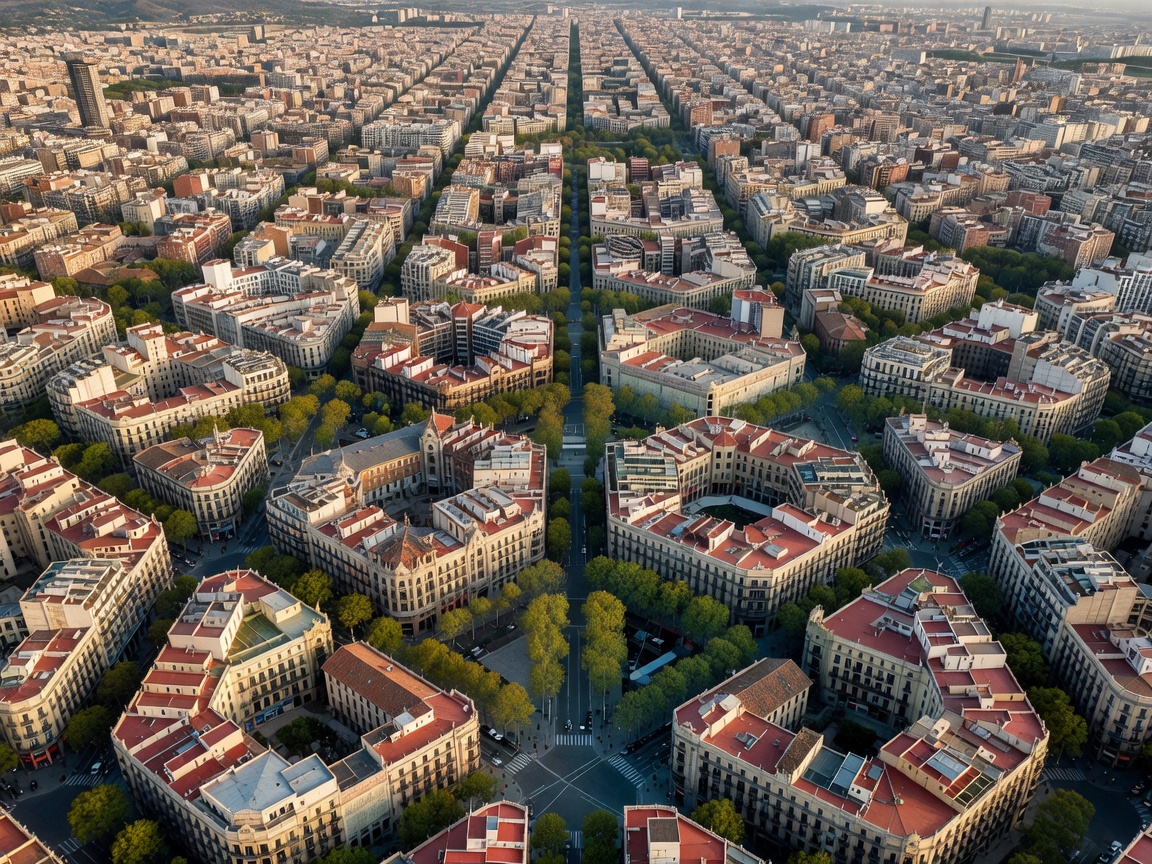
Ildefons Cerdà's nineteenth-century grid: wide, ordered, chamfered at every corner — the opposite of the medieval city below it.
Almost every visitor arrives with the same unspoken assumption: that staying inside the old city is automatically better, because that is where the photographs come from. It is not that simple. Barcelona's medieval core is beautiful, narrow, noisy and — in high summer — several degrees hotter than the grid above it, because there is nowhere for the heat to go. The Eixample, by contrast, is orderly, breezy, full of modernist architecture and almost entirely free of the drunken 3am street singing that defines certain Gothic Quarter streets in August.
What follows is a district-by-district assessment based on where our five reviewed hotels actually sit, with measured walking times rather than estimates.
1. Eixample (Dreta de l'Eixample)
Three of our five hotels are here: the Mandarin Oriental and the Majestic on Passeig de Gràcia, and Cotton House two blocks east on Gran Via. This is the part of Barcelona built after 1860 on Ildefons Cerdà's grid — wide avenues, chamfered corners, interior courtyards and the greatest concentration of Catalan modernist architecture anywhere.
What mornings are like. Bakeries and speciality coffee open from 8am, the pavements are wide enough to walk three abreast, and you can reach Casa Batlló or La Pedrera before the first coach group. Breakfast options are excellent and predominantly for locals.
What nights are like. Quiet by 11pm on the side streets, with a steady traffic hum on the major arteries — Gran Via, Aragó and Balmes carry serious volumes of cars. Double glazing is standard in all three hotels, but request an interior room if you are sensitive.
The catch. Passeig de Gràcia itself is a luxury shopping street with the footfall to match. Between 11am and 8pm in summer it is genuinely crowded, and the two blocks around Casa Batlló are among the busiest pieces of pavement in Spain.
2. Barri Gòtic and Port Vell
The Serras sits on Passeig de Colom, technically at the seaward edge of the Gothic Quarter. This is the best of both worlds: the medieval street plan begins immediately behind the hotel, but the front faces an open waterfront boulevard with light and air.
What mornings are like. Superb. The Cathedral cloister, Plaça Sant Felip Neri and the Roman wall remains are all empty before 9.30am, and the walk to the Boqueria takes fifteen minutes. This is the only district where you genuinely do not need public transport.
What nights are like. Variable by street. Carrer Ample and the lanes towards Plaça Reial get loud; the blocks nearer the Post Office building are calmer. Deeper inside the quarter — around Carrer d'Avinyó and Escudellers — noise runs until 3am on summer weekends.
The catch. Rooms are smaller and more expensive per square metre because the buildings are protected and cannot be reconfigured. Deliveries, cleaning trucks and rolling suitcases on stone create an early-morning soundscape all of their own.
3. Port Olímpic and Vila Olímpica
Hotel Arts stands alone here. The district was built for the 1992 Games and feels like it: generous, green, modern, with the coastal path and Nova Icària beach on one side and a well-planned residential grid on the other.
What mornings are like. The best in the city if you swim or run. The seafront path runs unbroken for kilometres, the beach is clean and shelved gently, and the Vila Olímpica market is a genuinely local affair.
What nights are like. The marina strip below the hotel has historically been a nightlife zone. The city has progressively reduced licences since 2021, and it is much calmer than a decade ago, but summer Fridays and Saturdays still carry sound up the lower floors.
The catch. Sightseeing distance. It is twenty-five minutes' walk or eight minutes by metro to the old city, which is not far — but you will feel it if your plan is to dip in and out of the centre four times a day.
4. Gràcia and Sant Antoni (the alternatives)
Neither district holds a hotel in this guide, but both are worth knowing. Gràcia, north of Diagonal, is a former village of low houses and small plazas with the most convincing neighbourhood life in the city. Sant Antoni, west of the Raval, has become Barcelona's best area for eating and drinking without tourist markup. Both are twenty minutes from the centre and suit a second or third visit.
Measured walking times
Walking times from each hotel district to major Barcelona landmarks
From
Sagrada Família
Cathedral
Boqueria
Barceloneta beach
Park Güell
Passeig de Gràcia (Mandarin / Majestic)
22 min
16 min
11 min
28 min
35 min
Gran Via 670 (Cotton House)
20 min
17 min
15 min
27 min
38 min
Passeig de Colom (The Serras)
33 min
9 min
15 min
12 min
50 min
Carrer de la Marina (Hotel Arts)
25 min
24 min
30 min
16 min
55 min
The decision table
Recommended Barcelona district and hotel by trip type
Interior rooms are not a downgrade in Barcelona. The Eixample's block structure means courtyard-facing rooms are significantly quieter and cooler, and often cheaper. Unless you specifically want a balcony, take the interior.
Check the Fira calendar before your dates. Mobile World Congress, ISE and the Alimentaria fair can double or triple rates across all four districts in the same week.
Budget for the tourist tax. Catalonia's regional levy plus the Barcelona municipal surcharge applies per person per night in all five hotels, and it is charged on departure rather than included in most online rates.
The best-located hotel in Barcelona is the one whose front door opens onto the version of the city you actually came for. Everything else is eight minutes on the metro.